.webp)
Why do public toilet doors never go all the way to the floor? Behind this surprising detail lie several practical reasons related to safety, cleanliness, ventilation and the functioning of the premises.
You've probably asked yourself this question before when entering a public restroom: why don't the doors ever touch the floor? This gap might seem strange, even awkward, but it's not there by chance. Behind this detail lie several very practical reasons related to safety, hygiene, ventilation, and even human behavior. A simple gap of just a few centimeters can actually make the place safer and easier to clean.
You've probably asked yourself this question before when entering a public restroom: why don't the doors ever touch the floor? This gap might seem strange, even awkward, but it's not there by chance. Behind this detail lie several very practical reasons related to safety, hygiene, ventilation, and even human behavior. A simple gap of just a few centimeters can actually make the place safer and easier to clean.
A matter of safety above all
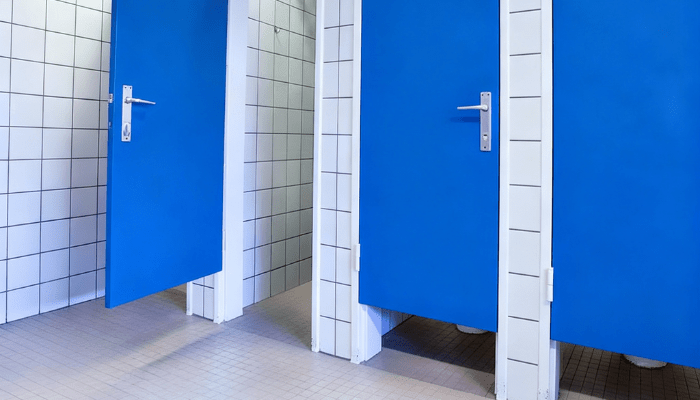
The first reason is safety. In a public place, someone might feel unwell, slip, or need assistance. Thanks to the space under the door, it's possible to see the person's feet and quickly understand if there's a problem.
This allows maintenance staff to intervene quickly in case of an emergency. Without this space, it would be much more difficult to know if someone needs help inside a closed cabin.
This detail may seem trivial, but it can actually allow for faster intervention in case of illness or a fall.
The first reason is safety. In a public place, someone might feel unwell, slip, or need assistance. Thanks to the space under the door, it's possible to see the person's feet and quickly understand if there's a problem.
This allows maintenance staff to intervene quickly in case of an emergency. Without this space, it would be much more difficult to know if someone needs help inside a closed cabin.
This detail may seem trivial, but it can actually allow for faster intervention in case of illness or a fall.
Much easier cleaning
The second reason is related to hygiene. Public toilets need to be cleaned very regularly, sometimes several times a day. The space under the door allows cleaning staff to easily mop or sweep without having to open each stall.
Water and cleaning products can circulate more easily, allowing for faster and more efficient cleaning. In high-traffic areas such as shopping centers, train stations, or airports, this detail saves a significant amount of time.
Ultimately, this space helps keep the toilets cleaner for everyone. It's an important element for the hygiene of public restrooms .
The second reason is related to hygiene. Public toilets need to be cleaned very regularly, sometimes several times a day. The space under the door allows cleaning staff to easily mop or sweep without having to open each stall.
Water and cleaning products can circulate more easily, allowing for faster and more efficient cleaning. In high-traffic areas such as shopping centers, train stations, or airports, this detail saves a significant amount of time.
Ultimately, this space helps keep the toilets cleaner for everyone. It's an important element for the hygiene of public restrooms .
Improved air circulation
Another important advantage is ventilation. Toilets are enclosed spaces where the air can quickly become stuffy. The space under the door allows air to circulate between the stalls and the rest of the room.
This air circulation helps reduce unpleasant odors and makes the space more pleasant for users. Without this space, more ventilation systems would need to be installed, which would be more expensive.
It is therefore a simple and effective solution to improve ventilation.
Another important advantage is ventilation. Toilets are enclosed spaces where the air can quickly become stuffy. The space under the door allows air to circulate between the stalls and the rest of the room.
This air circulation helps reduce unpleasant odors and makes the space more pleasant for users. Without this space, more ventilation systems would need to be installed, which would be more expensive.
It is therefore a simple and effective solution to improve ventilation.
A question of cost and sustainability
There's also an economic reason. Shorter doors are cheaper to manufacture, transport, and install. In a building with multiple cubicles, the price difference can be significant.
Furthermore, doors that don't touch the floor deteriorate less quickly. They are less exposed to water, cleaning products, and impacts. Therefore, they last longer and require fewer repairs.
For businesses and public institutions, it is a more economical solution in the long term.
There's also an economic reason. Shorter doors are cheaper to manufacture, transport, and install. In a building with multiple cubicles, the price difference can be significant.
Furthermore, doors that don't touch the floor deteriorate less quickly. They are less exposed to water, cleaning products, and impacts. Therefore, they last longer and require fewer repairs.
For businesses and public institutions, it is a more economical solution in the long term.
An effect on user behavior
There is also a more surprising reason: psychology. Specialists in the design of public spaces know that when toilets offer partial privacy, people tend to stay in the stall for a shorter time.
This prevents people from occupying the cabins for too long, especially in crowded areas. The process is faster and the queues are shorter.
It's a discreet way to manage the flow of people without anyone really noticing. This type of design is sometimes referred to as public restroom design .
There is also a more surprising reason: psychology. Specialists in the design of public spaces know that when toilets offer partial privacy, people tend to stay in the stall for a shorter time.
This prevents people from occupying the cabins for too long, especially in crowded areas. The process is faster and the queues are shorter.
It's a discreet way to manage the flow of people without anyone really noticing. This type of design is sometimes referred to as public restroom design .
A simple but very thoughtful detail
Ultimately, this space under the public toilet doors is not a construction error or a lack of finishing. It is a deliberate choice that serves several purposes: safety, hygiene, ventilation, cost reduction, and managing the flow of people.
The next time you enter a public restroom, you will see this detail differently, because behind this simple space lies a very clever design for everyday life.
Ultimately, this space under the public toilet doors is not a construction error or a lack of finishing. It is a deliberate choice that serves several purposes: safety, hygiene, ventilation, cost reduction, and managing the flow of people.
The next time you enter a public restroom, you will see this detail differently, because behind this simple space lies a very clever design for everyday life.
